 VapeWholesaleHub
Mountain Dew Ice Documentation Pack for Customs Brokers — Step by Step
A mountain dew ice programme fails in predictable ways: a specification nobody wrote down, a sample nobody retained, and a lead time nobody stress tested. Here is how to close those three gaps before they cost you a container.
Selling Mountain Dew Ice at Store Level
On shelf, mountain dew ice sells on clarity. A plain shelf talker that states strength and flavour in two words outperforms a beautifully designed but vague display, because most purchase decisions here take under ten seconds.
Rotate mountain dew ice facing rather than price for the first month. Visibility changes sell-through more reliably than a small discount, and it does not train customers to wait for offers.
How Mountain Dew Ice Fits the Assortment
Mountain Dew Ice sits at an interesting point in the assortment. It is familiar enough to be an impulse purchase and specific enough to build a repeat pattern around. Treating it as either pure commodity or pure specialty both lead to poor results.
Category planning for mountain dew ice works best when you map it against three shopper types: the restocker who already knows what they want, the switcher who wants something stronger, and the explorer who buys on flavour name alone.
Getting Mountain Dew Ice to Your Warehouse
Track mountain dew ice landed cost per unit as a running number, including duty and local delivery. It is the only figure that tells you whether a supplier change actually improved anything.
Where Demand Is Heading
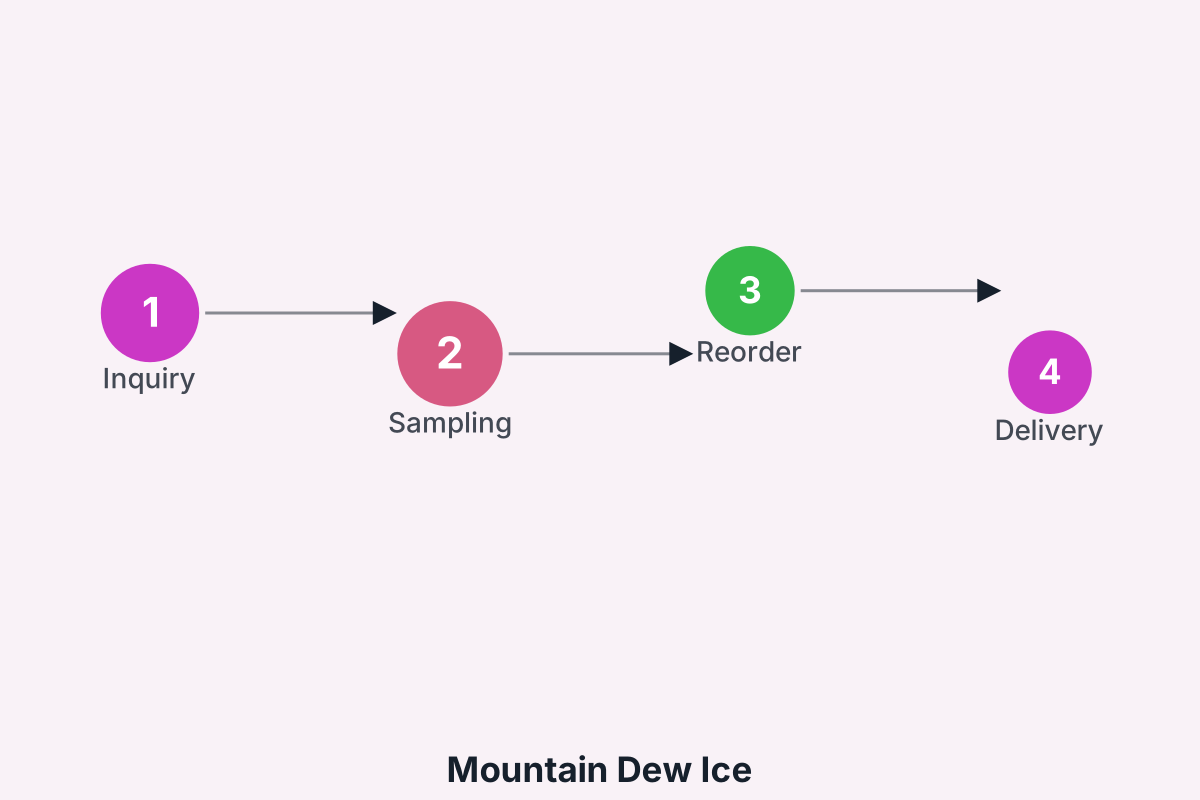
One shift worth planning for: shorter mountain dew ice reorder cycles with smaller average drops. It favours suppliers with flexible production slots over those who only want large annual commitments.
The Specification That Matters
Two specifications that matter more than buyers expect: the seal integrity after a drop test and the consistency of the draw from first use to last. Both are measurable before you commit to volume.
| Product category | Closed pod |
|---|---|
| Resistance band | 0.6 - 0.8 ohm |
| Capacity tolerance | +/- 5% |
| Puff count method | Declared by capacity |
| Master carton | 300 units |
| Carton weight | 9.4 kg |
| Shelf life | 24 months |
| Storage | 15-25 C, dry, away from direct light |
Inspection Before Dispatch
Inspection is only useful if the result is recorded somewhere you can find it later. A mountain dew ice batch log with weights, codes and measurements turns a future complaint into a five minute lookup.
- Rotate stock by batch code rather than by delivery date.
- Check carton dimensions against your freight quote before confirming.
- Confirm the current customs classification with your own broker.
- Plan the switch from air to sea freight before you need it.
- Start with a mixed carton and let your own sell-through decide.
Practical Checklist
- Plan the switch from air to sea freight before you need it.
- Check carton dimensions against your freight quote before confirming.
- Keep sealed retained samples from every production batch.
- Confirm the current customs classification with your own broker.
- Rotate stock by batch code rather than by delivery date.
- Agree the tolerance band in writing before approving artwork.
Frequently Asked Questions
Is there support for in-store material?
Yes. Shelf talkers, counter cards and simple planogram suggestions are available for mountain dew ice ranges that reach a sensible volume. Most retailers find the plain strength and flavour cards do the most work.
What if I only need a small first order?
That is normal and sensible. A mixed carton lets you test mountain dew ice in your own market before committing to a production run, and the specification you approve at that stage carries through to larger orders unchanged.
Do you provide compliance documents?
Every shipment leaves with the documentation set relevant to your market, including batch records and test reports where required. Your local rules still determine what you must file, so confirm those with your broker before import.
What happens if my market changes its rules?
Regulations move, and packaging or documentation sometimes has to follow. We keep approved artwork files on hand so that a required change is a reprint rather than a redesign, which keeps the cost and delay down.
How are price changes handled on repeat orders?
{K} pricing is reviewed against input costs and volume rather than adjusted casually. Any change is confirmed in writing before the next order is scheduled, with the reason stated so you can judge it yourself.
Next Step
Start smaller than feels comfortable, measure honestly, then scale what worked. That sequence has saved more of our customers money than any negotiation tactic we could suggest.
Related Reading
- Mountain Dew Ice Colour Matching Across Production Runs — a Printable Checklist
- Mountain Dew Ice Specification Change Control — Convenience Retail
- Mountain Dew Ice Sell Through Tracking Without Expensive Tools — Repeat Orders
- Mountain Dew Ice Strengths Ladder for a Balanced Cabinet — Real Numbers Only
- Mountain Dew Ice Customer Feedback Loops That Improve Reorders — Low Minimum Quantities
- Mountain Dew Ice Flavour Development: From Brief to Production — a Printable Checklist